










Immigrants in Austrian media - Waves of mistrust and misinformation
The current framework for the immigration debate is based on the assumption that the receiving society and the receiving state are often depicted to coincide. This means that within states there are diverse societies that may not share the political culture of the dominant society or state. As a result, the factors deriving immigration and its impact on these societies differ.

The public empathetic welcome was prevalent across Europe in the initial stages of refugee settlement. For example, Swedish Prime Minister Stefan Löfven, at the time when Sweden was receiving the highest asylum applications along with Germany, openly expressed his sympathetic tendencies towards the refugees in his public speech in September 2015 said, ‘My Europe takes in refugees. My Europe does not build walls’.
For the past 10 years in the European Union, the support for democracy and the trust in the EU has taken a blow among the member states. The inertia of trust in the EU is the product of rational evaluations, identity considerations, and national political stances.
Some studies have clearly shown that real-life events related to immigration impacts society’s views on the EU. Media framing of the EU impact the political knowledge and blame attributions in the minds of the public with varying degrees.
A report surfaced in the Norwegian media in 2009 found that 71 percent of the stories based on refugees and their integration within their own countries are focused on the problems they may cause. The media has dehumanised the refugees by showing them in a negative light that they violate procedures and try to cheat the system. According to studies, the possibility is that people dehumanise the refugees as they don’t want to compromise their privileged positions and keep the other group at bay. Thus, keeping the refugees out of their “human ingroup” and cultivating a social dominance orientation individuals may rely on their sentiment of negative treatment of the refugees.

Since the past decade, anti-immigrant parties have risen to power throughout Europe. Studies have suggested that media highlighting the issues of immigration has become the utmost topic of public concern. Media has the innate ability to create ownership of political issues with certain political actors in the minds of the voters. And if an issue is strongly linked with a political party, it becomes its core preceptor and cure. This is the reason why many new political parties have a sharp increase in their popularity within no time as they are perceived the flag bearers for anti- immigration.

The media's influence in highlighting immigration issues in the news, raises the prominence of this topic in the minds of viewers. Salience refers to the cognitive process through which an individual's focus is drawn to a specific issue, leading that issue to have a disproportionate impact on their future judgments and decisions.
As immigration coverage increases in the media, respondents’ attitudes toward immigration become more extreme, depending on their initial beliefs. Specifically, individuals with moderate positive views shift to highly favourable attitudes, while those with moderate negative views become significantly more concerned about immigration. This suggests that priming immigration issues can reinforce existing biases, contributing to greater polarization at the broader population level.
An analysis of heterogeneity also shows that polarization towards highly negative attitudes is more pronounced among younger individuals and those with right-wing ideologies, while polarization is stronger among highly skilled, employed individuals, and those with left-wing ideologies. These findings extend to the political realm, where voter polarization is evident in the growing support for candidates on the political extremes.
Right-wing populist parties in the EU which have long made anti-immigration—a central focus of their political platforms, are increasingly gaining prominence as key figures in public debates and as agenda setters, positioning themselves as having always recognized migration as a "problem".

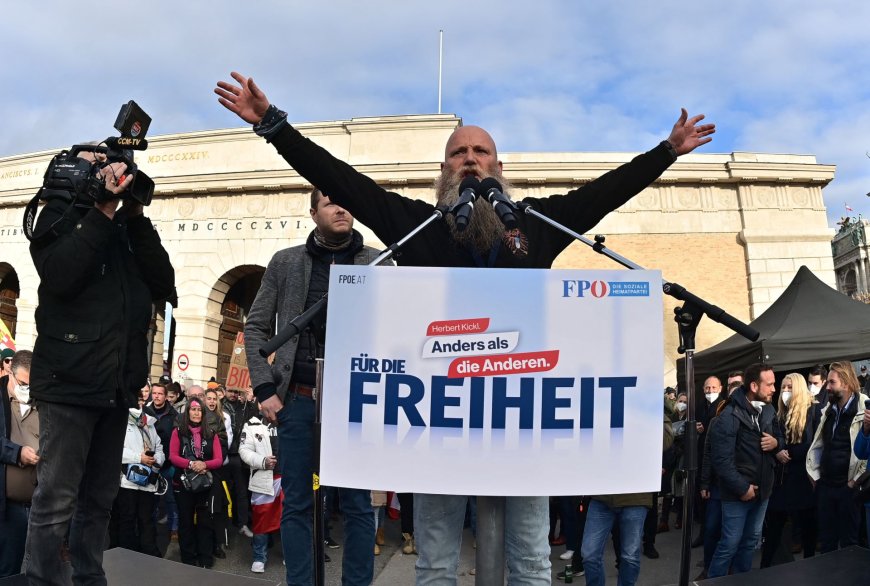
This is also true in Austria, where the activities of the far-right political party- FPÖ, helped make migration a mainstream political issue as early as the 1990s (e.g., with the 'Austria First Petition') and, as a result, shaped public opinion and pre-election debates around this topic. Since the mid-2000s, in response to social and political changes (such as the inability to oppose migration from former communist countries that are now EU members), the discourse has shifted toward focusing on refugees and asylum seekers from "third countries “rather than on migrants in general. This shift has evolved further in recent years, incorporating Islamophobic rhetoric that frames local migration issues within the broader context of global conflicts between cultures and religions[2] (Wodak & Krzyżanowski, 2008).
In the early 2000s, the FPÖ joined the Austrian federal government as a coalition partner with the conservative Austrian People’s Party (ÖVP). This move, however, triggered both national and international repercussions. On the international front, it resulted in sanctions imposed by the remaining EU-14 countries, in response to the inclusion of the FPÖ in the government because of its uncritical stance toward National Socialism and frequent use of antisemitic rhetoric.

The central focus of the Haider-led FPÖ’s discourse was a strong anti-immigration stance, a concern the party had prioritized since the early 1990s with campaigns like "Austria First". This focus became even more pronounced after the party entered the federal government in 2000. Anti-immigration slogans were quickly translated into official policies, with the 2002 Integration Agreement standing out as a key example. The FPÖ's anti-immigration rhetoric was often marked by the use of catchy yet ambiguous slogans, such as "the Right to Fatherland" (Recht Aufs Heimat). This slogan not only emphasized Austrians “right to live” in their own homeland but also echoed the call for migrants “right to return” to their countries of origin.
There is a notable Islamophobic discourse constructed in the FPÖ's campaign posters of 2009 Viennese local elections with slogans like "Away with Mosques and Minarets" (Aus für Moscheen und Minarete) or the 2008 National Election poster "At Home instead of Islam" (Daham statt Islam)—reveals a wide range of strategies that rely on "us" versus "them" oppositions. In the first poster, these oppositions are visually represented: "us" is symbolized by the smiling, vibrant image of HC Strache, while "them" is represented by a faint, "worried" image of Vienna’s long-serving social-democrat mayor, Michael Häuple.
While both posters emphasize the binary oppositions, the accompanying text further reinforces the general anti-Islam message. In the first poster, the visual contrast between Strache and Häupl is supported by claims that the Viennese mayor and other politicians, including those from the conservative ÖVP, have long avoided taking action against the spread of radical Islamist groups in Austria. These claims are then contrasted with the FPÖ's anti-Islam proposals, which assert that "preserving freedom and security means combating radical Islamism". Following this, a list of specific measures the FPÖ proposes in this "fight" is presented, including a "ban on the construction of mosques and minarets", "sermons only in German", and "no EU accession for Turkey and Israel". The use of anti-Turkish rhetoric is particularly notable, as the FPÖ's Islamophobic slogans are often exemplified by references to Austria's Turkish community.

The Islam Act of 2015 in Austria closely mirrored the Israelite Act of 2012. Unlike laws governing the Roman Catholic Church and the Protestant Church, the Islam Act of 2015 grants the state broad authority to intervene in internal religious matters. This approach harks back to the era of the Austro-Hungarian monarchy, particularly the late 19th and early 20th centuries when churches and religious groups were treated as state institutions, subject to the will of the Austrian emperor. This form of state-church relationship allowed the state to unilaterally determine the boundaries of internal church affairs[4] (Hafez & Heinisch, 2024).
FPO took the initiative to redefine the relationship between state authorities and the IGGÖ (Islamic organisation in Austria). The FPÖ began addressing the issue of Islam as early as 2005. In 2008, regional FPÖ leader Susanne Winter made a controversial statement labelling the last prophet of Islam as a child abuser. Later that year, the FPÖ unveiled its platform, "We and Islam" (Hafez 2009b), which included several restrictive measures on Muslim society such as surveillance of Muslim private schools, a mandate for religious education to be taught only in German, a proposed constitutional amendment to ban minarets, monitoring of mosques, and a ban on the hijab, among other provisions.
National tabloid media frequently portray immigrants and refugees in a negative light, often linking them to crime and illegality. In public discourse, there is a tendency to depict non-European immigrants as seeking to take advantage of Austria's generous population and welfare system in a broadly undifferentiated manner
What's Your Reaction?