





















The Crypto Rollercoaster: From Trump's Bull Run to Bitcoin's Bearish Turn (2024-2026)
The cryptocurrency market has always been a wild ride, but the period from 2024 to 2026 felt like strapping into a rocket-powered coaster. Donald Trump's re-election as president sparked an explosive bull run, with Bitcoin soaring to unprecedented heights. Analysts were buzzing with predictions of $150,000 per BTC, but reality hit hard—it never even touched $130,000. Fast forward to today, and Bitcoin has dipped below $67,000. In my view, we're heading toward a $35,000–$40,000 zone in the coming days. It might take some time, but the odds are high. Let's dive into what unfolded in the crypto world over these pivotal two years.


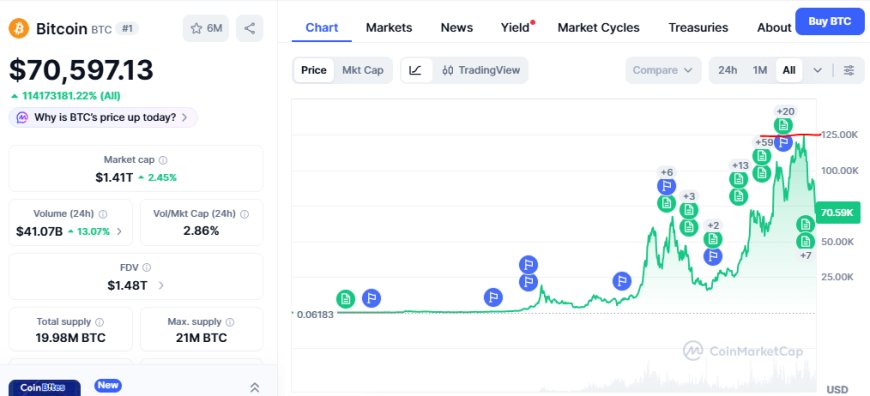
(Image: Coinmarketcap)
Bitcoin's Meteoric Rise: Politics Meets Decentralization
One thing I'll never fully wrap my head around is why crypto prices seem so tethered to U.S. market vibes and political drama, despite being a decentralized, globally adopted asset class. Pre-election, Bitcoin was grinding in the $50,000–$70,000 range, battling resistance at every turn. But when the election results rolled in, it was like flipping a switch for the bulls. The news was a massive win for crypto enthusiasts, propelling BTC first to $90,000, then $100,000, and ultimately to an all-time high of $125,000.
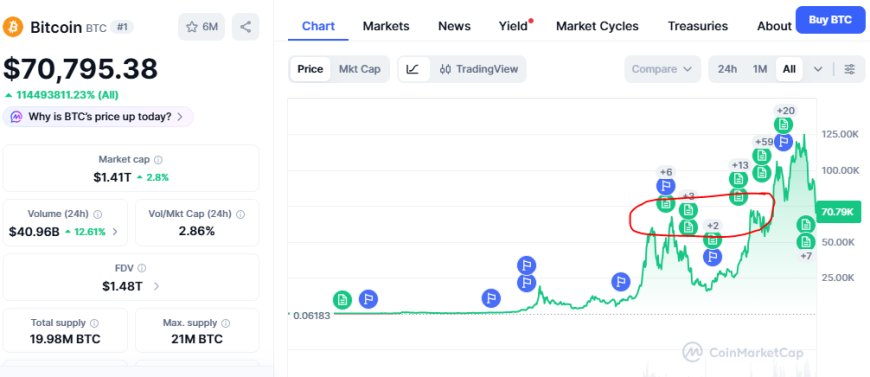
Behind this surge? Trump's pro-crypto rhetoric played a starring role. During his rallies, he championed Bitcoin and cryptocurrencies, even declaring that the U.S. would hold the world's largest Bitcoin reserves—positioning America as the dominant force in the Bitcoin market. "Gurus" across the space started forecasting a clean break above $150,000, fueled by this political tailwind.
From $60,000 at the start of 2024 to $125,000 by late that year, Bitcoin's journey was nothing short of spectacular. Yet, as 2025 dawned, cracks began to show, and the euphoria faded.
Institutional Moves: Short Bets vs. Long-Term HODLers
Not everyone rode the wave. While most institutional investors kicked off short positions—betting against the rally—one outlier stood tall: MicroStrategy. Ignoring the price dips, the company aggressively expanded its Bitcoin holdings. According to CoinMarketCap, MicroStrategy now boasts 712,647 BTC, valued at roughly $50 billion. Their strategy inspired a wave of corporate adoption, with firms allocating portions of their treasuries to Bitcoin reserves.
Here's a quick snapshot of key players following suit:
| Company | Bitcoin Holdings | Estimated Value (at ~$70K/BTC) |
|---|---|---|
| MicroStrategy | 712,647 BTC | ~$50 billion |
| MARA Holdings, Inc. | 53,250 BTC | ~$3.7 billion |
| Twenty One Capital | 43,514 BTC | ~$3 billion |
| XXI | 43,500 BTC | ~$3 billion |
| Metaplanet Inc. | 35,102 BTC | ~$2.5 billion |
MicroStrategy's latest power move? They announced on their X (formerly Twitter) account that they've hired Grayscale's former CEO. This could shake things up—watch closely to see how it influences their strategy and the broader market.

(Image taken from X account of Microstartegy)
Ethereum's Stagnant Saga: Upgrades Without the Uplift
If Bitcoin was the star of the bull run, Ethereum played the supporting role that never quite materialized. Despite the hype, ETH failed to eclipse its all-time high of $4,700—you can see it plainly on any price chart. Investors pinned their hopes on major network upgrades, dreaming of a post-update boom. Spoiler: It didn't happen. Prices stayed flat, leaving the community scratching their heads.
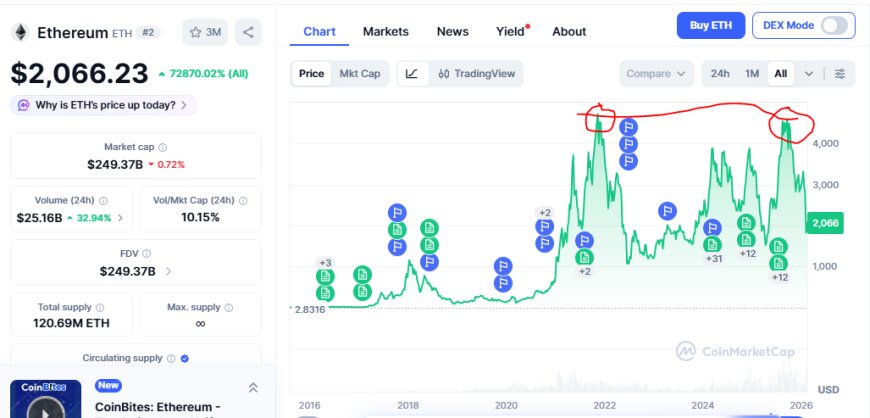
(Image: Coinmarketcap)
The Pectra Upgrade: A Leap for Staking and Scalability (May 2025)
Activated on May 7, 2025, Pectra (combining Prague and Electra) was Ethereum's most ambitious upgrade yet, packing in 11 Ethereum Improvement Proposals (EIPs). It focused on making the network more user-friendly and efficient:
- Staking Overhaul: Raised the maximum effective validator balance from 32 ETH to 2,048 ETH, sped up activations, and simplified independent withdrawals—ideal for institutional players.
- Account Abstraction Boost (EIP-7702): Smarter wallets with better UX, delegation options, and seamless interactions.
- Layer-2 Enhancements: Increased blob throughput for cheaper, faster L2 transactions, supercharging scalability.
Overall, Pectra made staking more accessible, polished the user experience, and deepened L2 integration. But the market? Yawn—no price fireworks.
The Fusaka Upgrade: Scaling Dreams Take Shape (December 2025)
Ethereum's 17th hard fork, Fusaka (Fulu + Osaka), went live on December 3, 2025, kicking off a new bi-annual upgrade rhythm. Its mission: Turbocharge scaling for rollups and Layer-2 solutions while preserving decentralization.
- PeerDAS Introduction: A precursor to full Danksharding, this lets nodes verify data availability without hoarding everything—slashing costs and unlocking up to 16x higher throughput in phases.
- Gas Limit Expansion: Reports suggest a bump to 150 million gas per block, cramming in more transactions.
- Blob Capacity Phasing: Gradual increases and tweaks for smoother, cheaper L2 operations.
Fusaka slashed L2 fees, accelerated settlements, and advanced the "Surge" phase of Ethereum's roadmap. Yet, December 2025 came and went without an ETH price surge. Upgrades built the foundation, but the bull market refused to show up.
AI Agents: The Unsung Heroes of 2025's Crypto Evolution
Amid Bitcoin's peaks and Ethereum's plateaus, a quieter revolution brewed: AI agents. These autonomous, AI-powered software entities run on blockchains, handling tasks without human micromanagement. In the crypto space, they're game-changers—automating lightning-fast trading via real-time analysis, fortifying security with fraud detection and smart contract audits, and optimizing portfolios with data-driven predictions.
Beyond trading, AI agents sift through on-chain data for smarter decisions, spawn "agentic economies" where bots interact independently, and streamline DeFi and NFTs. The result? Lower costs, reduced risks, and scaled innovation in a market that's anything but stable.
Standouts from 2025 include:
- Bittensor: Decentralized machine learning networks rewarding AI contributions.
- Fetch.AI: AI-driven agents for automated economic tasks.
- NEAR Protocol: High-speed blockchain with AI integrations for seamless dApps.
These weren't just buzzwords—they quietly dominated narratives, proving AI-blockchain fusion is crypto's next frontier.
Altcoin Season? Don't Hold Your Breath—But Smart Picks Could Pay Off
An altcoin season? I'm skeptical. The crypto market dances to Bitcoin's tune, and with BTC leaning bearish, altcoins face an uphill battle. That said, savvy investors can still cherry-pick winners for short-term trades and lock in profits. Focus on fundamentals to spot opportunities amid the chaos.
Key factors to evaluate:
- Market Cap: Gauges size and stability—mid-caps often offer the best risk-reward.
- Total and Circulating Supply: Watch for scarcity plays; low circulating supply can signal upside.
- Recent Price Action: Look for coins bucking the bear trend with strong volume.
- Exchange Listings: Top-tier spots like Binance or Coinbase boost liquidity and credibility.
In this $35K–$40K Bitcoin world, patience and analysis will separate the HODLers from the traders. The 2024–2026 saga reminds us: Crypto's decentralized promise shines brightest when politics, upgrades, and innovation collide—but gravity always pulls eventually. What's your take on the next move? Drop a comment below!
What's Your Reaction?